Coagulation and Flocculation in Water Treatment
Optimizing Coagulation and Flocculation in Water Treatment
How Proper Chemical Dosing Improves Water Quality, Protects Reverse Osmosis Systems, and Reduces Operating Costs
Water treatment is more than simply adding chemicals to raw water. Across Lagos and Nigeria, many commercial buildings, estates, hotels, hospitals, manufacturing plants, and data centers struggle with poor water quality because the coagulation and flocculation process is poorly designed or improperly operated. This write up will assist in providing information on Coagulation and Flocculation in Water Treatment.
At RP Facilities Limited, we frequently encounter water treatment plants where excessive chemical consumption, cloudy treated water, blocked filters, or frequent reverse osmosis (RO) membrane fouling can be traced back to one common issue—ineffective coagulation and flocculation.
This guide explains how coagulation works, why it is essential, and how selecting the right chemicals and operating conditions can significantly improve water quality while reducing operating costs.
What is Coagulation in Water Treatment?
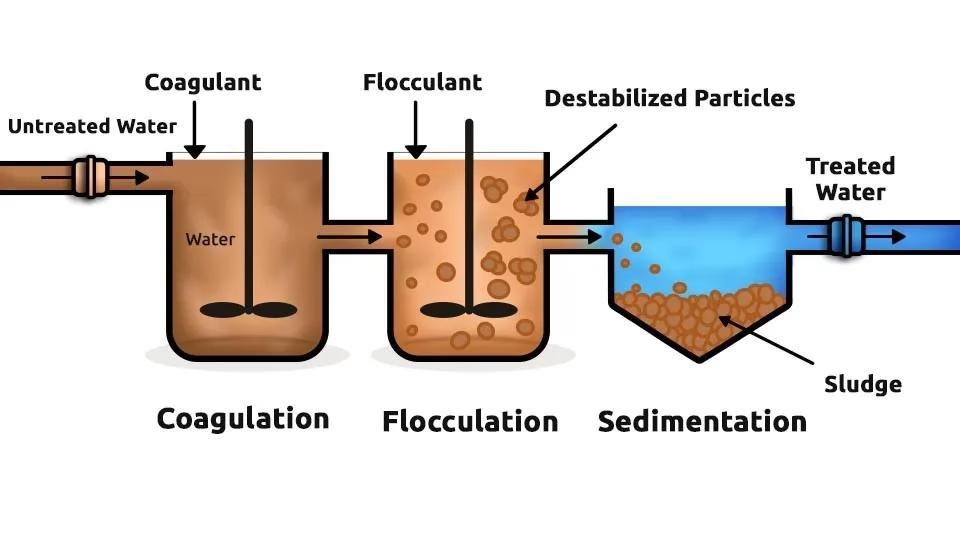
Coagulation is the first major chemical treatment stage used to remove suspended particles, colour, organic matter, and microorganisms from raw water.
Most contaminants in water are microscopic and carry negative electrical charges. Because these particles repel each other, they remain suspended in water and cannot settle naturally.
During coagulation, positively charged chemicals called coagulants neutralize these charges, allowing tiny particles to come together.
The resulting larger particles are called microflocs.
These microflocs are then gently mixed during the flocculation stage to form larger, heavier flocs that settle inside sedimentation tanks.
Why Coagulation is Important
Effective coagulation provides several benefits:
- Reduces turbidity
- Removes colour and odour-causing compounds
- Reduces organic contaminants
- Improves filtration efficiency
- Protects activated carbon filters
- Extends FRP filter media lifespan
- Protects Reverse Osmosis membranes from fouling
- Reduces chemical consumption during final disinfection
For facilities operating Reverse Osmosis plants, effective pretreatment is often the difference between membrane replacement every two years versus every five years or longer.
How the Coagulation Process Works


The typical treatment sequence is:
- Raw water enters the treatment plant.
- A coagulant (such as alum or PAC) is injected.
- Rapid mixing disperses the chemical.
- Flocculation gently combines particles into larger flocs.
- Sedimentation allows heavy flocs to settle.
- Filtration removes remaining suspended matter.
- Final disinfection and, where required, Reverse Osmosis treatment produce potable water.
Each stage depends on the previous one being properly designed and operated.
Factors That Affect Coagulation and Flocculation in Water Treatment
Many operators assume chemical dosage is the only important factor. In reality, several variables determine treatment efficiency.
1. Water Temperature
Cold water slows chemical reactions.
Low temperatures reduce:
- particle collision
- floc growth
- settling speed
This often requires:
- higher coagulant dosage
- longer flocculation time
- improved mixing control
2. Water Alkalinity
Alkalinity acts as a natural buffer during coagulation.
Low alkalinity can cause:
- poor floc formation
- unstable pH
- ineffective coagulation
Where alkalinity is insufficient, chemicals such as lime may be added before coagulation.
3. Turbidity
Surprisingly, both high and very low turbidity can create treatment challenges.
Very low turbidity means there are fewer particles available to collide and form flocs, making coagulation less effective.
High turbidity generally requires increased coagulant dosage and closer process control.
4. Water pH
pH is one of the most critical parameters affecting alum performance.
Alum performs best between:
pH 6.5 and 8.5
Outside this range:
- flocs become weak
- settling becomes poor
- chemical consumption increases
Routine pH monitoring should therefore be part of every treatment plant operation.
5. Mixing Energy
Two stages of mixing are required.
Rapid Mixing
Rapid mixing disperses the coagulant evenly throughout the water.
If mixing is insufficient:
- poor particle contact occurs
- coagulation becomes incomplete
Slow Mixing (Flocculation)
Slow mixing encourages flocs to grow.
If mixing is too vigorous:
- flocs break apart
- sedimentation efficiency drops
If mixing is too gentle:
- flocs never become large enough to settle.
6. Coagulant Dose
Finding the correct dose is essential.
Too little chemical results in:
- poor clarification
- high turbidity
- ineffective filtration
Too much chemical can result in:
- residual aluminium
- coloured treated water
- unnecessary operating costs
- excessive sludge production
This is why jar testing is considered industry best practice before selecting a final chemical dosage.
Common Coagulants Used in Nigeria
Several primary coagulants are commonly used in industrial water treatment.
| Coagulant | Typical Application |
|---|---|
| Aluminium Sulphate (Alum) | Municipal and industrial water treatment |
| Ferric Chloride | High turbidity water |
| Ferric Sulphate | Industrial applications |
| Ferrous Sulphate | Specialised treatment |
| Polyaluminium Chloride (PAC) | High-performance coagulation with wider pH tolerance |
Among these, alum remains the most widely used in Nigeria due to its availability, cost-effectiveness, and ease of handling.
Why Alum Remains the Most Popular Coagulant
Aluminium Sulphate offers several advantages:
- readily available across Nigeria
- relatively inexpensive
- simple to handle
- accurate dosing
- highly effective over a wide range of water qualities
It performs best when:
- water pH is between 6.5 and 8.5
- sufficient alkalinity is present
However, operators should note that alum solutions are corrosive to unprotected aluminium, steel, and concrete tanks. Proper protective linings or compatible dosing equipment should therefore be used.
What Are Coagulant Aids?
Sometimes primary coagulants alone are insufficient.
Coagulant aids improve:
- floc density
- settling rate
- floc strength
- filtration performance
Common coagulant aids include:
- Sodium Aluminate
- Bentonite
- Cationic polymers
- Anionic polymers
- Nonionic polymers
Although polymer products can significantly improve clarification, they are considerably more expensive than traditional coagulants. Proper dosing and optimisation are therefore essential to avoid unnecessary operating costs.
Understanding the Jar Test


The Jar Test is one of the most important laboratory procedures in water treatment.
It simulates the coagulation and flocculation process using multiple beakers containing identical raw water samples but different chemical dosages.
The objective is to identify the optimum dosage before full-scale plant operation.
Benefits include:
- reduced chemical costs
- improved clarification
- lower sludge production
- better filtration performance
- protection of downstream RO membranes
Example Jar Test Chemical Preparation
Typical laboratory preparations include:
| Chemical | Standard Solution |
|---|---|
| PAC | 1% solution |
| Polymer | 0.1% solution |
| Water Sample | 500 mL |
A commonly used calculation is:
Chemical Dose (ppm) = (Chemical Volume (mL) × Solution Strength (%) × 10) ÷ Sample Volume (L)
Example:
PAC
- 1 mL × 1 × 10 ÷ 0.5 L = 20 ppm
Polymer
- 1 mL × 0.1 × 10 ÷ 0.5 L = 2 ppm
These results provide a starting point for determining the optimum chemical dose, but the final dosage should always be confirmed by observing floc formation, settling characteristics, and treated water quality.
Common Water Treatment Problems in Lagos and Nigeria
Based on our field experience, some of the most common issues include:
- Overdosing alum due to lack of jar testing
- Incorrect pH during coagulation
- Poorly maintained dosing pumps
- Inefficient mixing systems
- Undersized sedimentation tanks
- Blocked or exhausted filtration media
- High turbidity reaching RO membranes
- Frequent membrane fouling caused by inadequate pretreatment
- Poor operator training
- Lack of routine water quality monitoring
These issues often increase operating costs and reduce equipment lifespan.
Best Practices for Reliable Water Treatment
To achieve consistent treatment performance:
- Conduct routine laboratory analysis.
- Perform jar tests whenever raw water quality changes.
- Monitor pH, turbidity, and alkalinity regularly.
- Calibrate dosing pumps periodically.
- Maintain proper mixing energy during coagulation and flocculation.
- Replace exhausted filtration media as recommended.
- Protect RO membranes through effective pretreatment.
- Keep detailed operational records to identify trends and optimise performance.
Why Coagulation and Flocculation in Water Treatment Design Matters
Every water source is different. A system designed for a borehole in Lekki may not perform effectively in Ajah, Ikeja, Victoria Island, or other parts of Nigeria due to differences in groundwater chemistry, salinity, turbidity, and microbial content.
Selecting the right combination of coagulants, filtration media, FRP vessels, and Reverse Osmosis technology requires proper water analysis and engineering design. A well-designed system not only improves water quality but also reduces chemical consumption, extends equipment life, and lowers long-term operating costs.
At RP Facilities Limited, we provide comprehensive water treatment solutions, including raw water analysis, system design, FRP filtration systems, Reverse Osmosis plants, chemical dosing optimisation, commissioning, and ongoing maintenance support for residential, commercial, and industrial facilities across Lagos and Nigeria.
Frequently Asked Questions (FAQ)
What is the best coagulant for borehole water in Nigeria?
There is no universal answer. Alum is widely used because it is cost-effective and readily available, but the best coagulant depends on water quality, pH, alkalinity, turbidity, and the intended treatment process. Jar testing should always be carried out before selecting a chemical and dosage.
Why is my treated water still cloudy after filtration?
Cloudiness after filtration often indicates poor coagulation, inadequate flocculation, exhausted filter media, incorrect chemical dosing, or insufficient settling time. A review of the pretreatment process is usually required.
Can poor coagulation damage Reverse Osmosis membranes?
Yes. Inadequate coagulation allows suspended solids and organic matter to reach the RO membranes, leading to fouling, higher operating pressures, reduced permeate flow, and more frequent chemical cleaning or membrane replacement.
How often should a jar test be performed?
Jar tests should be conducted whenever there is a noticeable change in raw water quality, after seasonal changes, or when treatment performance declines. Routine testing helps optimise chemical dosage and minimise operating costs.
SEO Keywords Naturally Covered
water treatment in Lagos, water treatment company in Nigeria, reverse osmosis systems Nigeria, FRP water treatment vessels, coagulation and flocculation,
alum dosage for water treatment, PAC water treatment,
jar test procedure, industrial water treatment, borehole water treatment, potable water treatment, commercial water treatment systems, RO pretreatment, water treatment chemicals Nigeria
These keywords align with common search intent while keeping the content informative and useful for engineers, facility managers, and property owners.